By Jackson He
March 2, 2026
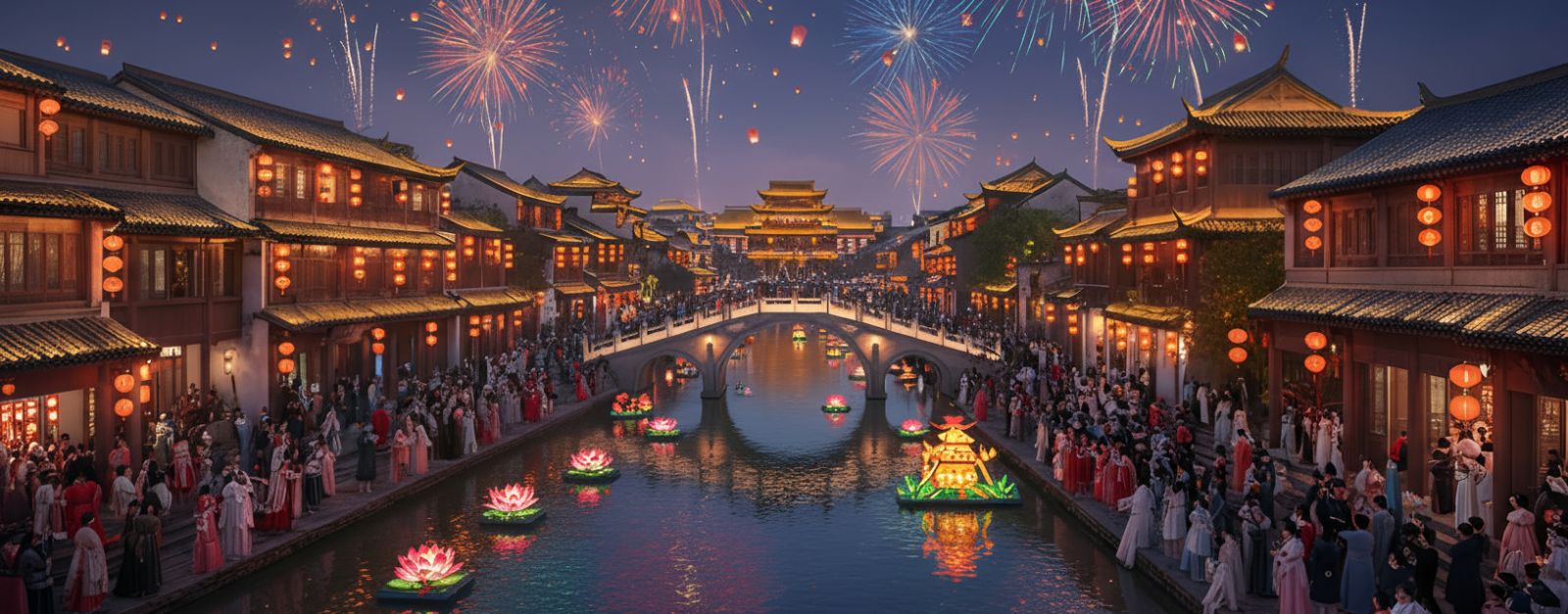
The Lantern Festival is on the 15th day after the Lunar new year. With a history of at least two thousand years, it is celebrated throughout China, and around the world wherever there is a significant Chinese diaspora. (Koreans celebrate Daeboreum, an unrelated festival, on the same day.)
As I explained previously, Lunar New Year is the most important holiday in many east Asian countries. And when a holiday of such importance comes about, celebrating it for only one or two days feels downright disrespectful. Traditionally, the start of the Lunar New Year, named Spring Festival in China, is on different days for different regions and families, but the Lantern Festival is its definitive end. Since the Lunar New Year is always on a new moon, the Lantern Festival always falls on a full moon.
Oddly, the name Lantern Festival is not a translation of its Chinese counterpart. The Chinese name for the Lantern Festival is Yuanxiao Jie. While Jie is the Chinese word for festival, Yuanxiao is completely unrelated to lanterns. Yuanxiao is a kind of boiled food, white in color, with the size and shape of common meatballs, made of glutinous-rice-flour shells and sweet fillings, and eaten with the soup it is cooked in.
There is no record on why Yuanxiao Jie became Lantern Festival. But I do have a couple of guesses. One is that the concept of the Yuanxiao is hard to explain. While Chinese restaurants are found everywhere in the world, Yuanxiao is not on the menu in most of them, not even in China! Secondly, the letter "x" in Yuanxiao denotes a phoneme that is absent from most western languages, as far as I know. Not only is it not present in English, it’s also missing from Spanish, Franch, German, and Italian. As a food that the general English-speaking population knows nothing about, and with a name that is tricky to pronounce by non-Chinese-speakers, Yuanxiao is essentially untranslatable.
This is not to say that lanterns are not a part of the Lantern Festival. I remember getting lanterns during the Spring Festival season, ones that were covered with thin rice paper, and lit inside with a candle. The candle was as thin as a chopstick, about 4 inches long, invariably red in color, and burned long enough me to have a lot of fun wandering the alleys (called Hutong in Beijing), but not too long for me to forget the hour to go home. The only thing is, I remember having these lanterns for the Spring Festival, and therefore not particularly for the Lantern Festival.
Lanterns also play a literal role during the Lantern Festival. What I’m talking about is lantern puzzles (Deng Mi), which has a significantly shorter history, only about 900 years. Traditionally, these were puzzles written on lanterns. But nowadays, it’s not unusual for puzzles to be written on paper, but still referred to as lantern puzzles. The puzzles often relate to how the Chinese characters forming the clues or answers are composed from individual parts, and many also relate to some ancient text, such as popular poems, or common idioms.
The Spring Festival celebrations, the merriment, the easy life, the pigging out, lasts until the Lantern Festival. After it, the new year’s farming cycle starts. The name Spring Festival really meant to evoke the sense that spring is coming. You may question the wisdom of using the Spring Festival as the marker for the start of the spring season. After all, the Lunar New Year generally falls between late January and early February, and yet in the west, the start of spring is much later, on the spring equinox (for 2026 that falls on March 20th) or shortly before that. As a traditional agricultural society, how could the Chinese get it so wrong?
The “mistake” is completely intentional. The Chinese farmers believe strongly in starting the season early. Before birds started to sing outside the window, before buds can be spied on trees and shrubs, even before the ground is completely thawed, preparatory work for a new season of farming is afoot. Plows and hoes are sharpened, irrigation channels repaired, and seed stock double-checked. Starting early ensures a better prepared farming season, which is crucial for a population that depends on extracting the maximum amount of food from the scarce arable land. I suspect that starting the season early is also good to condition the farmer, body and soul, for the hard labor ahead.
“If Winter comes, can Spring be far behind?” Shelley famously wrote. Farmers in China may not know Shelley, or his poem, but they may also eagerly anticipate the oncoming spring, and the new year of good harvest it may bring. A Chinese proverb that is somewhat less romantic but more practical goes like: a great snow foretells a year of abundance.
In 2026, the Lantern Festival falls on March 3rd.